How One Team Achieves 15× Value Delivery
People love the idea of Product Builders or have limited understanding of how it works. Small teams. Fewer handoffs. Ship in days instead of weeks.
Then someone asks: “But how does it actually work?”
Fair question. Because without an operating system, the Product Builder model is just a reorg with better branding. You’ll get the same chaos, faster.
I’ve talked to dozens of product leaders who gave their teams AI tools and expected transformation. Most got marginal improvements. The ones who saw real results? They didn’t just adopt tools — they redesigned workflows, roles, and ownership. That’s the difference between 25% productivity gains and 15× value delivery.
Here’s the operating model I built at Aerones over few months. The one that produces 15× results.
Two roles, non-negotiable
The model runs on two complementary roles. Remove either one and it breaks.
The Portfolio Manager (Senior PM or VP Product) owns the strategic layer. Which domains get priority this quarter. How capacity is split. Cross-domain coordination and GTM. They’re the air traffic controller — they don’t fly the planes, but without them you get collisions.
The Product Builder owns a single domain end-to-end. Not a feature list — a domain. The customer problems in that space, the solutions, the delivery, and the adoption. They decide what to build and how within the strategic frame.
The distinction is altitude. Portfolio Manager operates at quarterly roadmap level. Product Builder operates at weekly execution level. When everyone knows their lane, politics disappear.
The pair: PB + Technical Partner
Every Product Builder works with a Technical Partner from day one. Not a handoff — a partnership. In some cases there can be even two or three technical partners if the space is complex and requires more technical expertise and development than just building out a product experience.
The PB builds roughly 70% of the final product using AI tools. The TP handles the remaining 30% — architecture, deployment, code quality, the engineering depth that AI tools can’t match.
I need to be honest about this: software built by non-developers with AI tools will not be as good as an experienced engineer’s work. The quality gap is real. And that’s precisely why the pair forms early — not at the review stage, but from day one.
The pair compensates for the quality gap honestly. Speed from the builder. Depth from the partner. Together they ship fast AND well. And the second point is that the pair reduces business risks and ensures continuity in case anything happens to one of them.
Decision rights
The single most important document in this model fits on one page. Three columns. Who decides what.
- Portfolio Manager decides: Which domains are priority. How capacity splits. Cross-domain sequencing. Portfolio GTM. Major strategic or customer commitments.
- Product Builder decides: Which problems to solve. Feature prioritization (cap at ~10 items — forces real choices). UX and workflows. When to ship. How to drive adoption.
- Technical Partner decides: Architecture and technical design. Code quality standards. Shared services vs custom build. Feasibility and performance.
Clear decision rights eliminated about 80% of our coordination meetings at Aerones. When everyone knows their lane, you don’t need a meeting to figure out whose call it is.
The operating loop
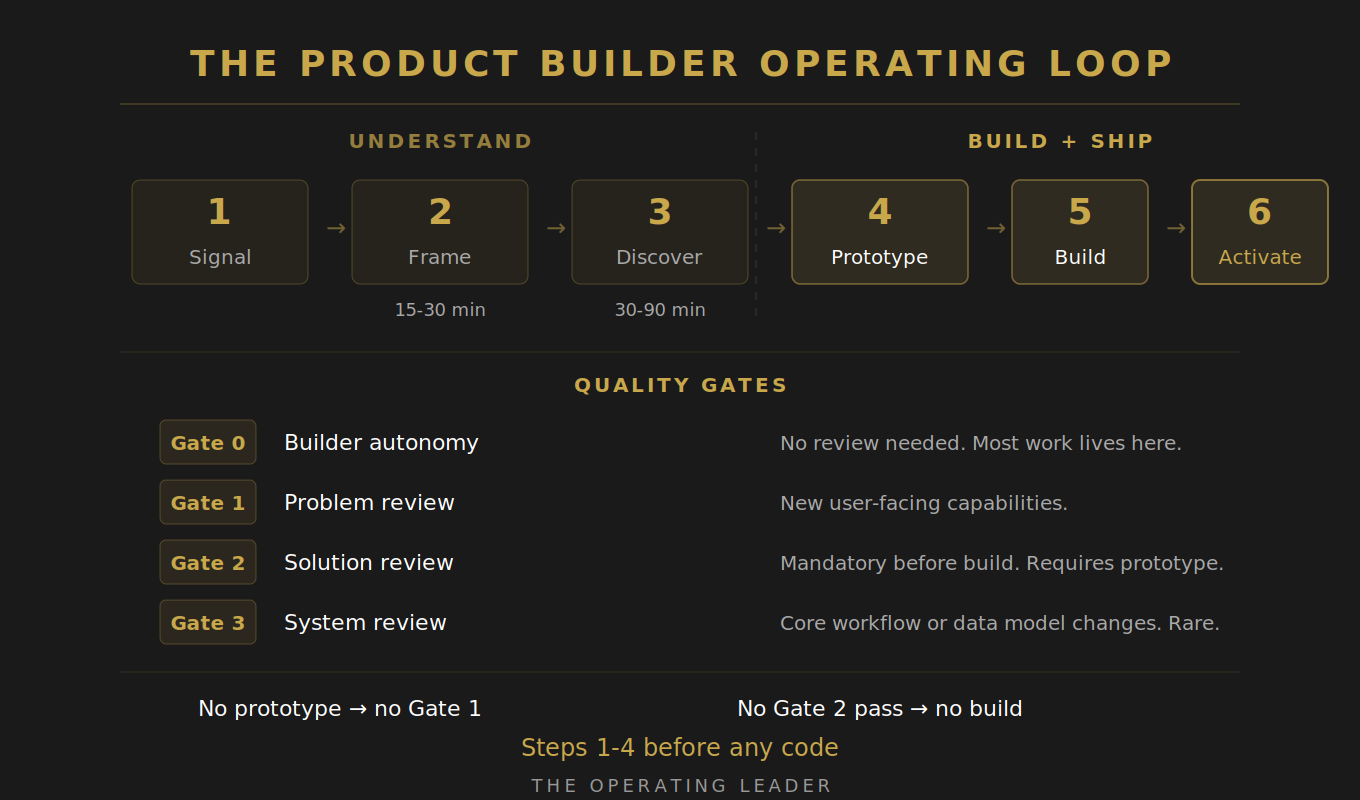
This is the heartbeat of how Product Builders work day to day. Six steps:
- Signal Intake — capture the customer request, ops feedback, or observed friction. Don’t design yet.
- Frame the Opportunity (15-30 min) — who’s the user, what’s the problem/opportunity or what’s broken, what’s actually needed vs. what’s asked for. If there’s no clear value, stop here.
- Lightweight Discovery (30-90 min) — identify 1-3 assumptions. Pull fast evidence. Define one success metric. Not a 3-week sprint — enough validation to place a bet.
- Prototype and Iterate (mandatory) — clickable prototype or mockups before any code. Claude artifacts, Figma, annotated screens. Test with a real user. Iterate 2-3 times minimum.
- Build — PB builds with AI tools, TP handles architecture and hard engineering. Pair on complex parts. Buggy but shipped beats perfect and planned.
- Ship and Activate — in-product guidance, knowledge base, demo, training if needed, adoption metrics instrumented. Not done until users are using it and extracting value from the product.
The key rule: steps 1-4 happen BEFORE any code. Skip discovery and you build the wrong thing fast. Speed without direction is waste.
Anton Osika, the founder of Lovable — which hit $10M ARR in 60 days with 15 people — put it simply: the biggest bottleneck is shifting from “who can build it?” to “who knows what to build?”
Quality gates
Gates sound bureaucratic. They’re the opposite — they’re what lets builders move fast on 80% of work while catching the 20% that could cause real damage.
- Gate 0: Builder autonomy. Small, reversible changes. No review needed. This is where most daily work lives. This is where the speed comes from.
- Gate 1: Problem definition review. New user-facing capabilities. Quick check: right problem? Right user? Scope thin enough? Takes 30 minutes, prevents weeks of rework.
- Gate 2: Solution and design review. Mandatory before building anything with non-trivial UX or data model impact. Requires clickable prototype, user flow with edge cases, clear success metric.
- Gate 3: System and precedent review. Rare. Core workflow or data model changes. Escalates immediately.
Non-negotiable: No prototype → no Gate 1. No Gate 2 → no build. No Gate 3 bypass, ever.
What “done” actually means
A feature is not done unless:
- It solves a real, validated problem
- UX flows are coherent end-to-end
- Edge cases, error states, and empty states exist
- Adoption is instrumented and monitored
- Enablement exists — demo, knowledge base, training if needed
Most product teams ship code and call it done. Product Builder teams ship outcomes. The difference is adoption.
The 15× math
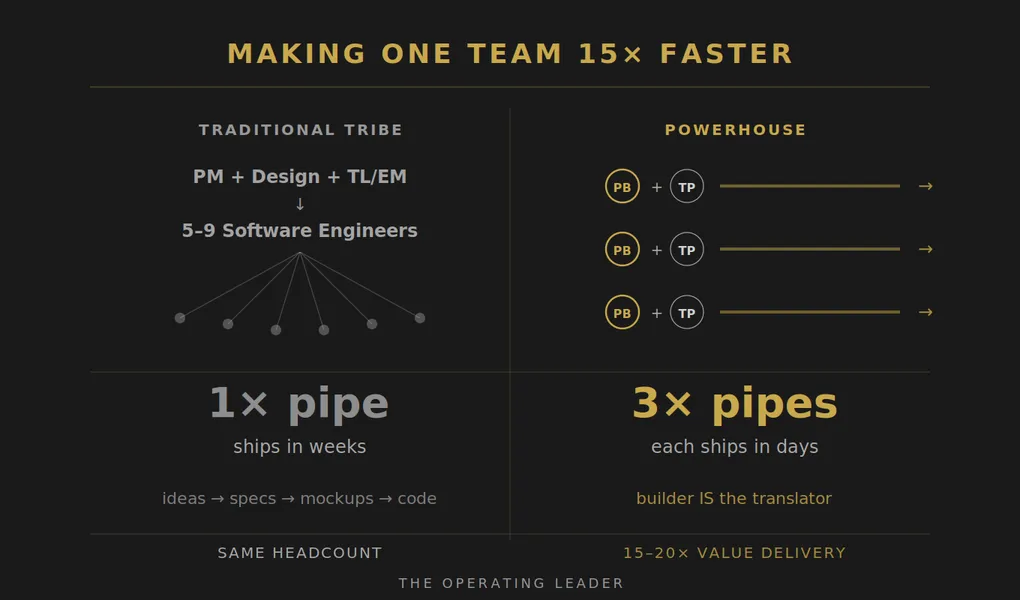
A typical product tribe/team/squad — PM, Designer, Tech Lead, 5-9 engineers — creates one pipe. Everything flows through the same funnel. Throughput: weeks or months per meaningful feature. Every idea goes through a chain of translations: idea → spec → mockup → ticket → code. Each translation loses fidelity.
Restructure that headcount into three PB + TP pairs. Three parallel pipes, each shipping in days. The translation tax almost disappears.
The 15× comes from two observable factors:
- Cycle compression (5-8×) — a feature that took 8-12 weeks now takes a PB+TP pair about 1 week. Eliminated handoffs, AI-assisted building, faster feedback, thinner slices. 5× is the conservative floor.
- Parallelization (3×) — three pairs shipping simultaneously instead of one sequential pipeline
3 × 5 = 15×. Same people. Different structure. Different results. At maturity, the number is higher.
Claire Vo predicts the PM-to-builder ratio will shift from 1:7 to about 1:20 as AI tools mature. The structural transformation is just beginning. She points out that the output is increasing 3x, but I’m challenging the idea, that we should have less PMs, we should turn those teams of 8, into 4 Product Builders and 4 Technical Partners.
This is the operating model I built at Aerones over a few months. I’m sharing the full playbook — operating loop templates, quality gate checklists, decision rights matrix, and onboarding guide — with leaders making this transition. DM me on LinkedIn or reach out at operatingleader.com.
Next in this series: Pick Up the Hammer — what happens to engineers and PMs when you make this shift, and how to handle the identity crisis on both sides.
📘 The Team Health Playbook — Diagnose, fix, and maintain healthy teams. 40+ diagnostic questions, 3 action playbooks, and a weekly pulse framework.
Get the Playbook →