The Cascade Most Leaders Skip
I caught myself doing it in the spring of 2014. Mailigen, Riga office, a Wednesday afternoon. I was rewriting the annual plan I’d built three months earlier — not because the strategy had changed, but because I needed it to match what the team was actually shipping.
That was the moment.
The plan hadn’t held. It had drifted. And rather than dragging the work back to the plan, I was quietly retconning the plan to fit the work. I was protecting my own sense of being on top of things. The plan was a doc. The work was real. The two had stopped meeting somewhere in February, and by April I was the only person in the company who would have noticed — and I was hiding it from myself.
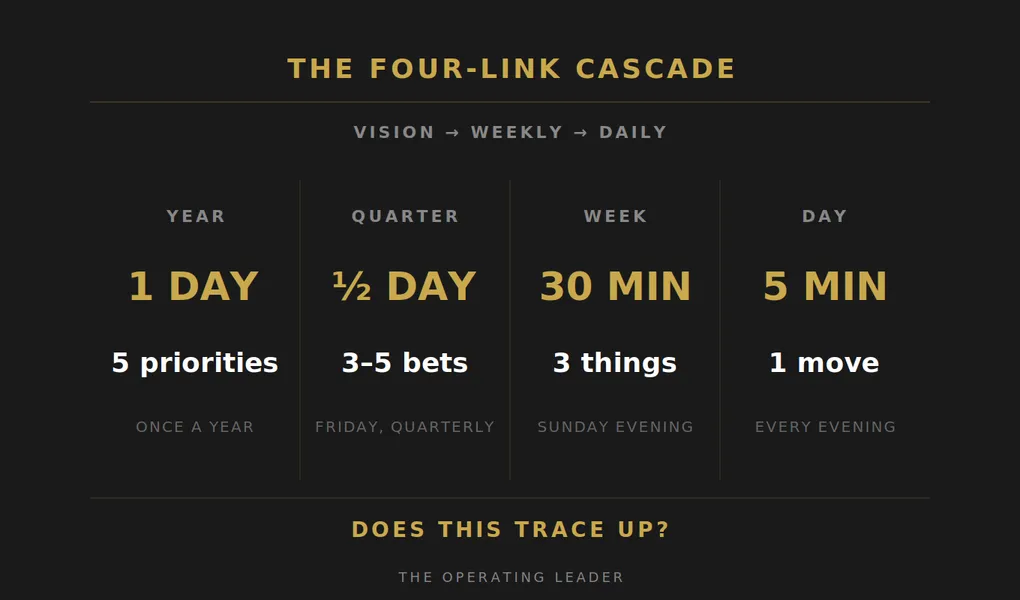
That spring is when I started building what I now call the four-link cascade. Year → Quarter → Week → Day. One page, four cadences. I’ve used the same template for twelve years. It moved with me into Pipedrive, into Aerones, into how I run my own week now.
This is the version of it I wish I’d had in 2014.
The two-link trap
Most leaders run a two-link chain.
January: an annual plan. Strong themes, real bets, a clear year. People agree, the deck looks good, the leadership team feels aligned for the first time in months.
Then: weekly execution. Sprints, tickets, standups, ship.
The middle drops out. The plan goes into a doc nobody opens. The work goes into Linear. The two never meet again, except in retrospective decks that quietly massage the work to match what was supposed to happen.
By April, the team isn’t off-strategy. There just is no live strategy. There’s a January artifact and an April backlog, and nobody is doing the connecting work on Tuesdays.
Plans don’t die in December. They die on Tuesdays.
This isn’t a discipline problem. It’s a structural one. Two links can’t carry the load.
The four links
The leaders who keep the plan alive run four links, each with its own cadence and its own job. The cadences are not arbitrary. The duration is the discipline.
Year — one day, once a year
A full day. Not a half-day, not a long evening. The job at this link is to pick five priorities for the year, max. Not seven, not “and a few stretch goals.” Five.
The constraint matters more than the list. Five priorities is short enough that you can repeat them from memory in front of your team. If you can’t, the team can’t ladder their work up to them, which means the rest of the cascade can’t work.
Anything that doesn’t connect to one of the five is decoration. You’ll be tempted to keep some of the decoration. Don’t.
Quarter — half a Friday, every quarter
Friday afternoon, not Monday morning. You want the week’s work in your head when you do it, not theoretical Monday energy. Block half the day, kill notifications, write the quarter on paper.
The job at this link is three to five quarterly bets that move the year. Bets, not tasks. A bet has a hypothesis: if we do X, we expect Y to move. If a bet doesn’t connect to a year priority, kill it. If you can’t articulate what would move, it’s not a bet — it’s a project with a deadline.
Most quarterly plans I’ve seen fail here. They’re project lists pretending to be strategy.
Week — 30 minutes, every Sunday
Sunday evening. Before the week starts. Not Monday morning when the inbox already owns you.
Pick the three things this week that move a quarterly bet. Three. The rest is maintenance — answer the emails, attend the meetings, be a decent colleague. But the three are the ones you’d defend if someone asked Friday what you actually moved.
This is the link that breaks most often. Leaders who plan years and quarters skip the weekly review because they “already know what they’re doing.” That’s the lie. What they’re doing is reacting. The weekly review is the difference between operating the week and surviving it.
Day — five minutes, every evening
Five minutes before you sleep. One move tomorrow that earns the day.
Not a to-do list. One move. The thing that, if it happens, makes tomorrow count. Write it down before you go to bed. When you wake up, the decision is already made. Your brain doesn’t have to negotiate with itself in the morning.
This link costs almost nothing. It compounds the most.
The rule that holds the cascade together
There’s one question that does most of the work. At every link, you ask it.
Does this trace up?
Today’s one move — does it connect to this week’s three things? The week’s three — do they move a quarterly bet? The bets — do they ladder up to a year priority?
If you can’t connect today’s work to a quarterly bet, and the bet to a year priority, you’re in motion, not in the cascade. Motion feels productive. It rarely is.
The trace-up question is also the team-version question. When someone reports a deliverable, you don’t ask “is it done?” You ask “what does it trace up to?” Answers like “the platform team asked for it” or “we always do this in Q2” are red flags. Real answers connect a Tuesday line of work to a year-priority bet in two sentences.
The team mirror
Once the personal cascade works, the team version mirrors it almost beat for beat:
- Annual offsite — one day, once a year. Same five-priority constraint.
- Quarterly review — half a Friday, every quarter. Same bet framing.
- Weekly leadership rhythm — Monday morning, 30 minutes. Same three-things discipline.
- Daily standup — five minutes. Same “one move” question.
Same shape, same job, same duration. What changes is who’s in the room.
This is the part most operating systems get wrong. They invent different shapes for the team — OKRs at the company level, sprints at the team level, standups at the individual level — and the shapes don’t translate. The four-link cascade is the same shape at every altitude, which is what lets it actually cascade.
Total time cost across personal and team versions: under 4% of working hours. That’s the price of having a plan that’s still alive in April.
What the cascade actually buys you
After twelve years of running this — through Mailigen, through Pipedrive’s unicorn arc, through Aerones during AI restructure, through my own independent year now — here’s what the cascade actually produces:
Clarity. You always know which link you’re operating in, and what the job is at that link. No ambient anxiety about whether you’re working on the right thing.
No fear. The plan doesn’t depend on memory. It depends on the cadence. Miss a day, miss a week, the cascade is still there waiting. You don’t fall behind — you re-enter.
Confidence. When you walk into the leadership meeting, you can trace any active project up to a year priority in two sentences. So can the team — because the cadence taught them how.
Results. The compounding kind. The kind that shows up in December and feels like luck, but isn’t.
This is not motivation. It’s a structure that produces those four states whether or not you feel like it that morning.
Where to start
Don’t try to install all four links at once. Start with the weakest one.
For most leaders, the weakest link isn’t the year. It’s the week. It’s the link that gets skipped first when calendars get busy, and it’s the link that produces the worst version of motion-without-trace. Block 30 minutes this Sunday. Pick three things that move a quarterly bet. Just that.
Next Sunday, do the same thing. The week after, add the daily five minutes. After that, schedule your next quarterly review.
The year link only matters once you’ve proven the others. A year plan without a working weekly cascade is just a January artifact, and we already know how that one ends.
This article is the long-form version of an issue of The Operating Note — bi-weekly, ~5-minute read, one operating insight at a time.
📘 The Team Health Playbook — Diagnose, fix, and maintain healthy teams. 40+ diagnostic questions, 3 action playbooks, and a weekly pulse framework.
Get the Playbook →