The Value Creation Stack: Why Most Companies Get the Sequence Wrong
I spent over 10 years building Mailigen without a system. We grew to few million in revenue, got acquired — from the outside it looked like we knew what we were doing.
We didn’t. We were winging it.
Every quarter was a new experiment. No operating plan, no structured cadence, no connection between what we said we’d do and what actually shipped. We survived on hustle and luck. And I didn’t even realize what we were missing until I walked into Pipedrive.
That’s where I first saw the stack.
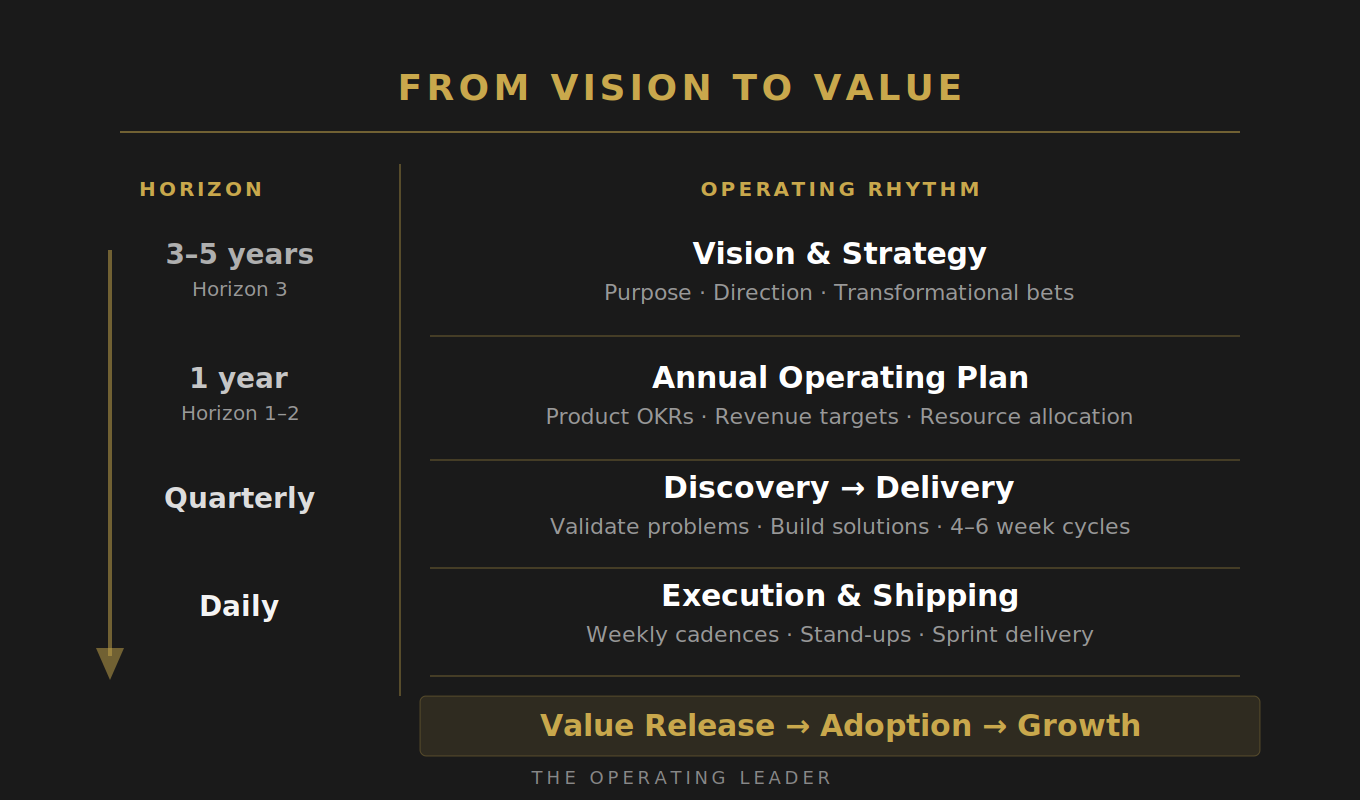
Three Layers. One Machine.
Think of value creation like building a house. You can’t put the roof on without walls, and you can’t build walls without a foundation.
Layer 1: Resources. Money, capital, runway. Without enough fuel to stay alive while you figure things out, nothing else matters.
- Startups: Personal savings + initial revenue that covers 6–12 months
- Growth stage: Revenue that covers next month’s payroll and still leaves room to try something new
- Scale: Growth capital + strategic reserves for the long game
The mistake I see constantly: companies raise money, then immediately burn it on hiring without building the systems to make those hires productive. Your resources need to match your ambition horizon. Can’t build a 5-year vision on 3-month runway.
Layer 2: People. Right talent, right skills, right structure. At Mailigen we had smart people, but we never thought about whether we had the right people organized the right way. At Pipedrive, org design was a real discipline — you map your strategy, then you map your people to it. Not the other way around.
We learned this the hard way at Aerones too. We hired brilliant engineers who wanted to build cutting-edge robotics. Problem was, our customers needed reliable maintenance solutions first, innovation second. Right people for the wrong strategy is an expensive failure.
The fix: hire for where you’re going, not where you’ve been.
- 1-year horizon needs operators
- 3-year horizon needs builders
- 5-year horizon needs visionaries
Layer 3: Systems and Processes. This is where most founders drop the ball — I know because I dropped it for years. Processes sound boring. They’re not. They’re the difference between consistent quality and random wins. Good systems ensure quality of thought and quality of execution. They turn a group of talented individuals into a team that delivers predictably.
And here’s the thing — you can’t skip layers. I’ve seen founders hire amazing people (layer 2) while running out of cash (layer 1). I’ve seen companies with solid processes (layer 3) but wrong talent (layer 2). Each layer depends on the one below it.
Only when all three layers work together does the top of the stack kick in: sustainable customer value creation. Not accidental. Not hero-dependent. Consistent. Customers stay and grow. Net revenue retention hits 100%+. That’s when you know the machine is running.
From Vision to Value: The Operating Cascade
The stack tells you what you need. The operating cascade tells you how the work flows.
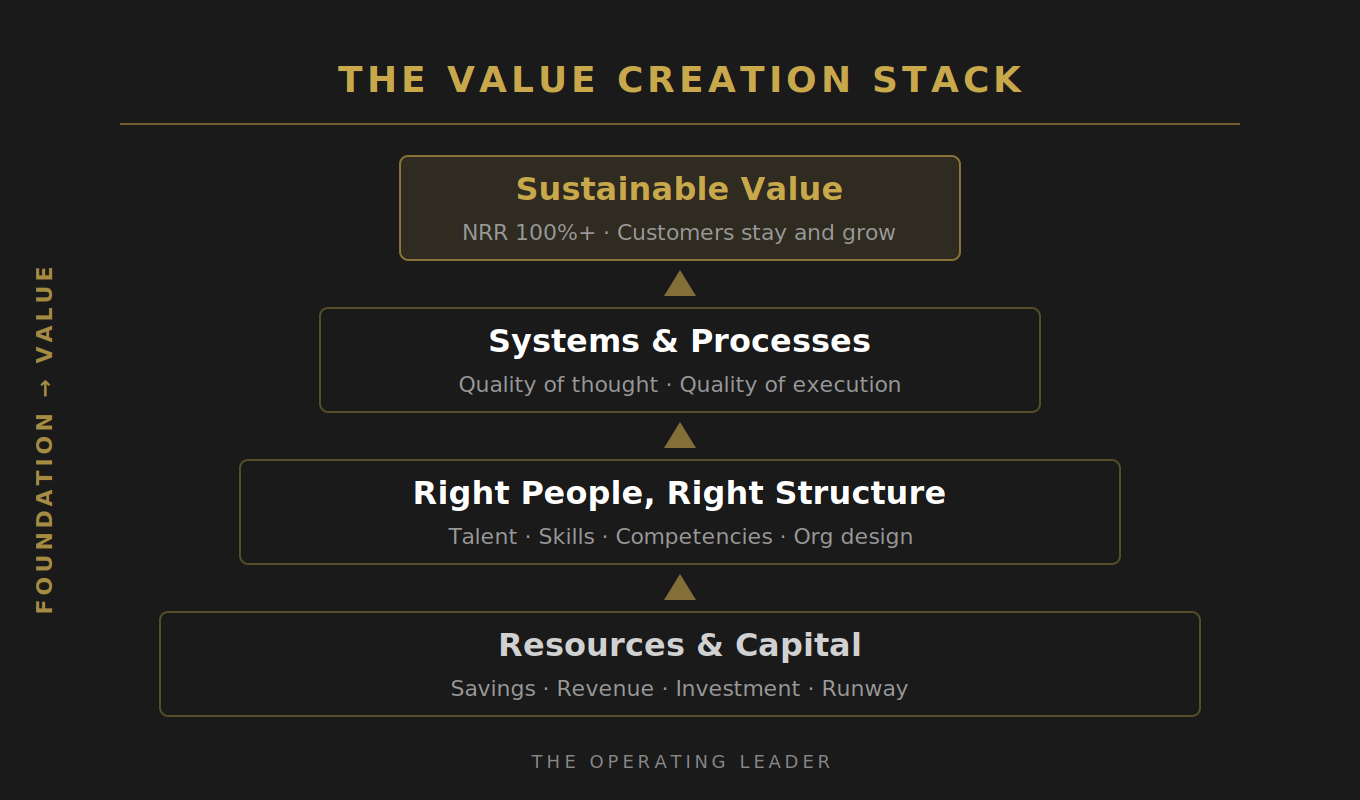
It starts with a long-term vision — where are you headed in 3 to 5 years? I think about this using McKinsey’s three horizons:
- Horizon 1 (this year): Core business. This funds everything else. If H1 isn’t healthy, H2 and H3 are fantasies. You need efficiency here — tight execution, predictable delivery, happy customers.
- Horizon 2 (years 2–3): Emerging opportunities. These should be resourced experiments, not side projects hoping for attention. You need agility here — small teams, fast learning, permission to fail.
- Horizon 3 (years 4–5): Future bets. These need protected resources and patience. They’ll look like failures until they don’t. The worst thing you can do is judge H3 work by H1 metrics.
The mistake most companies make: running all three horizons with the same processes. H1 needs efficiency. H2 needs agility. H3 needs patience. Mix them up and you’ll kill innovation while slowing down the core.
That vision feeds into an Annual Operating Plan — what are we actually going to accomplish this year? What are the product and R&D OKRs that connect to the business goals?
From there, you move into discovery and delivery cycles. Discovery is where you figure out what to build — identifying the biggest customer problems, exploring solutions, validating before committing resources. Delivery is where validated solutions get built and shipped on a 4–6 week quarterly cadence, aligned across teams.
But here’s where most companies lose the plot. They build stuff and move on to the next thing. The last mile — communicating to internal teams, training on new capabilities, actually getting customers to adopt what you built — that’s where value is actually released. Ship it and land it. Otherwise you just created inventory, not value.
What Changes When You Install This
At Mailigen, daily standups were status updates to nowhere. A customer complained, we fixed it. A competitor launched something, we panicked and built a response. There was no system connecting our strategy to our daily work.
At Pipedrive, I learned how a real operating system works. Annual planning that connects to quarterly roadmaps. Discovery processes that validate before we commit engineering time. Delivery cadences that create predictability instead of chaos.
Then at Aerones, I installed it. Took the same thinking — stack, cascade, horizons — and built it from scratch in a robotics company that had been running on founder intuition.
The difference was immediate. Not because the framework is magic. But because it forces clarity. You stop debating what’s important because the operating plan already answered that. You stop reinventing how to work every quarter because the cadence is set. More systemic. More disciplined. More predictable growth.
The Innovation Paradox
“But won’t all this process kill our startup energy?”
That’s what I thought at Mailigen. Turns out, the opposite is true.
When your core business runs on systems — when delivery is predictable and customer value is flowing — you actually create space for innovation. You can fund it. You can dedicate time to it. You can protect it from the gravitational pull of urgent customer requests.
At Aerones, our systematic approach to core operations freed up 20% of engineering time for pure R&D. Those experiments? They became our next growth drivers.
Innovation doesn’t thrive in chaos. It thrives in organizations that have their core business handled so well that they can afford to take real bets on the future.
Chaos doesn’t breed innovation. Stability does.
How You Know It’s Working
One metric tells you if your value creation stack is running: Net Revenue Retention.
Below 100% — you’re losing value every year. Your product isn’t sticky enough or your service isn’t strong enough to keep what you’ve already won.
At 100% — you’re treading water. Customers stay but don’t grow.
Above 110% — you’re creating compound value. Customers expand. The flywheel is turning.
Best in class runs 120%+. That only happens when all three layers work together — resources to invest in customer success, people who understand customer needs, and systems to deliver value consistently.
Start Where You Are
I didn’t know any of this at Mailigen. We built on pure hustle and made every mistake in the book.
If you’re early stage — start simple:
- Map your real runway (not the optimistic version)
- Audit your team against next year’s strategy, not last year’s
- Pick one system to build this quarter — start with a planning rhythm
If you’re further along:
- Separate your three horizons with distinct resources and metrics for each
- Build the full cascade from vision to daily execution
- Measure NRR religiously — it’s your truth serum
The companies that win aren’t the ones with the most resources, the best people, or the perfect systems. They’re the ones who stack all three in the right order and let compound effects do the work.
Stop pushing the boulder. Build the machine.
Yes, this is how mature companies think. The question is whether you want to learn it at 20 people or discover it at 200 — when it’s a lot more painful.
📘 The Team Health Playbook — Diagnose, fix, and maintain healthy teams. 40+ diagnostic questions, 3 action playbooks, and a weekly pulse framework.
Get the Playbook →